A RAS system price is usually only part of the money needed to start a fish farm. The investment also has to cover the building, site services, installation and the months when fish are growing but customer payments have not yet arrived. A useful estimate therefore gives you three figures: the cost of the installed farm, its annual operating costs and the cash needed to reach regular sales.
This article first puts published cost estimates in context, then works through a 100-tonne example. The USD figures in that example are teaching assumptions, not current market prices or an Aquafarmer quotation.
What published RAS cost estimates actually cover
The 2022 FAO/Eurofish guide gives an indicative capital cost of EUR 12–20 or more per kilogram of annual production for complete indoor RAS facilities, including hatchery, fry and grow-out systems. It also describes simple outdoor grow-out modules at around EUR 6 per kilogram of annual production at scales of at least 1,000 tonnes. That lower estimate excludes buildings and intake-water treatment. These are the author's dated planning estimates for different scopes, not interchangeable offers. Source: Bregnballe, 2022, printed pages 51–53.
The unit matters. USD 15 per kilogram of annual capacity would mean USD 1.5 million for a facility designed to produce 100,000 kg a year. It does not mean that growing a kilogram of fish costs USD 15. Nor can a figure from a large farm simply be scaled down to price a 50-tonne project: staffing, backup equipment and site connections still need to be provided.
Before comparing offers, put the species, harvest size, annual saleable output and scope on the same page. A hatchery-to-harvest salmon facility and a tilapia grow-out unit buying juveniles are different businesses, even if both quotations use the word “turnkey”.
Build the installed-farm budget
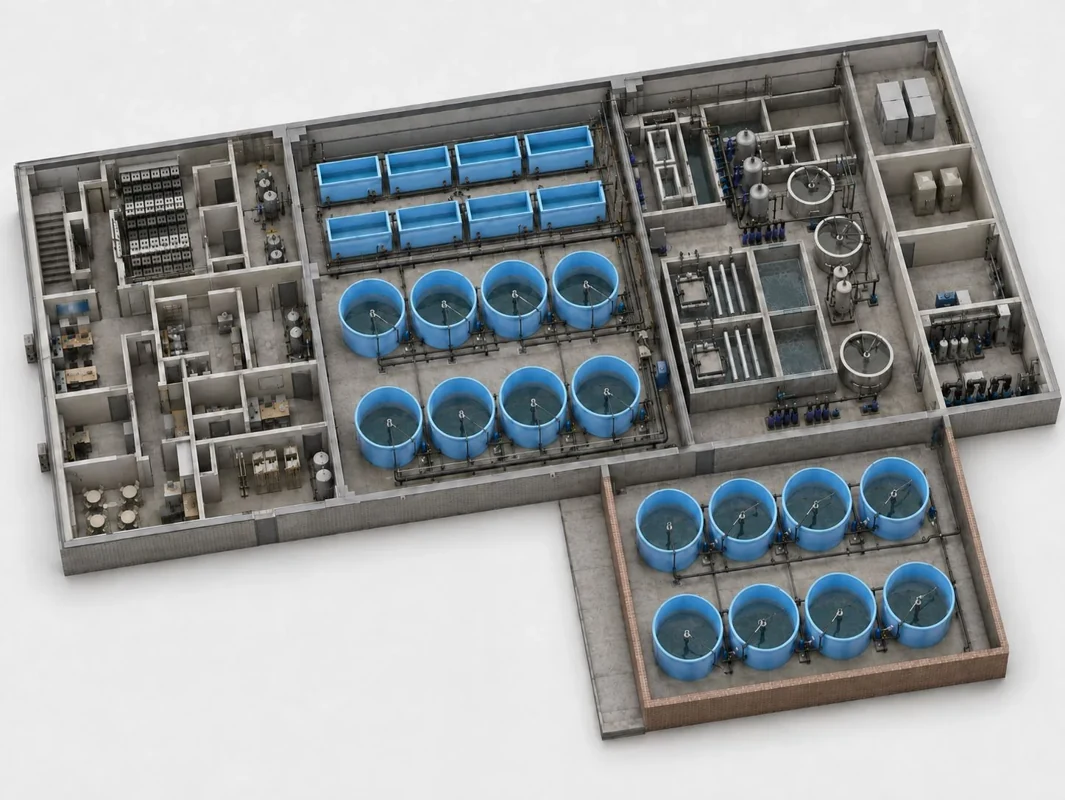
Our example is a grow-out farm targeting 100,000 kg of whole fish sold per year after ramp-up. It uses an existing building that needs preparation, buys juveniles and has no hatchery or processing plant. Its capital expenditure, or CAPEX, is allocated as follows.
| Capital item in the worked example | USD | What the allowance covers |
|---|---|---|
| Fish production equipment | 650,000 | Tanks, treatment, circulation, feeding, controls and handling equipment |
| Building preparation and internal services | 300,000 | Floors, drains, internal utilities, heating, cooling and ventilation equipment |
| External water and utility works | 180,000 | Connections, intake preparation and effluent handling |
| Emergency systems | 120,000 | Backup power, emergency oxygen and alarms |
| Engineering and delivery | 250,000 | Design, freight, installation, commissioning, training and initial spares |
| Total CAPEX | 1,500,000 | Before the separate contingency and operating cash below |
The important document behind this table is a scope schedule. Each item has a supplier, a price basis and an inclusion or exclusion. For example, “electrical works included” should say whether it means wiring inside the fish hall or also a transformer and the connection to the public network. Civil works and site services can change the investment substantially without changing the tank count.
The example assumes the existing building is already available without rent. It excludes land purchase, a new building, import duties, taxes and financing costs. Those are not zero-cost items: add them where applicable, including rent if the property is leased. Recoverable taxes may still need cash while a refund is outstanding. Delivery currency and payment dates also matter when equipment and sales use different currencies.
Allow enough cash to grow and sell the first batches
Starting cash comes from a monthly payment schedule. Include initial juveniles, feed, wages, utilities and other operating payments, then subtract the customer receipts expected in each month. Fish in tanks and invoices awaiting payment cannot pay the next feed bill.
Suppose the cumulative operating shortfall is USD 60,000, 140,000, 180,000 and 150,000 at four successive review points. The largest shortfall is USD 180,000. With a separate USD 150,000 contingency, the example needs USD 1,830,000: USD 1.5 million CAPEX + USD 180,000 starting cash + USD 150,000 contingency. The contingency is a chosen allowance, not a prescribed percentage.
Initial stock and feed are already included in that operating shortfall. Adding them again, or adding a full year's operating costs, would count the same payments twice. For a financed project, put loan drawdowns, interest and repayments into the monthly schedule as well; the amount the owner must provide can then differ from the total project funding requirement.
Calculate operating costs for a full production year
The next table describes a year with 100,000 kg produced and sold, broadly unchanged fish and feed stocks, and no material change in unpaid bills or customer debt. It is an annual operating estimate, not the first-year cash budget.
| Operating item | Basis in the example | USD/year |
|---|---|---|
| Feed | 135,000 kg used × USD 1.20/kg | 162,000 |
| Electricity | 700,000 kWh × USD 0.10/kWh | 70,000 |
| Juveniles and health management | Annual allowance | 35,000 |
| Staffing | Wages and associated employment costs | 70,000 |
| Water, oxygen and consumables | Including treatment chemicals and waste removal | 20,000 |
| Maintenance and routine replacements | Service, parts and regular equipment upkeep | 25,000 |
| Insurance, administration and selling | Including ordinary harvest packing and delivery | 18,000 |
| Total modelled operating costs | USD 400,000 ÷ 100,000 kg sold | 400,000; USD 4.00/kg |
The feed ratio is 1.35 kg used per kilogram sold, including losses within this example. It is not a species-specific biological FCR. A real feed budget follows each batch's weight gain, mortality and feeding programme; it also accounts for fish still growing at year end.
All temperature control in this example is electric and included in the 700,000 kWh, along with circulation, ventilation and other farm loads. Oxygen is purchased and included in the consumables allowance. A farm generating oxygen on site would move that cost into electricity and equipment maintenance. Gas, purchased heat or a processing line would need their own entries if used.
At USD 5.00/kg, sales bring in USD 500,000, leaving USD 100,000 after the costs shown. That balance is before depreciation, finance costs, tax and major capital replacements. USD 4.00/kg is therefore the price needed to cover these particular operating costs at full output, not the price needed to repay the investment.
Find the assumptions that can change the decision
| Change from the base case | Effect on annual result | Balance after modelled operating costs, USD |
|---|---|---|
| Base case | Sales 500,000 − costs 400,000 | 100,000 |
| Selling price falls 10% | Sales fall by 50,000 | 50,000 |
| Feed price rises 20% | Feed costs rise by 32,400 | 67,600 |
| Electricity tariff rises 50% | Electricity costs rise by 35,000 | 65,000 |
| All three changes occur | Sales 450,000 − costs 467,400 | −17,400 |
Each individual change starts from the same base case. The combined row shows why a project should not rely on every favourable assumption holding at once. It also gives the commercial work a purpose: a written buyer specification, delivered feed price and site utility offer can resolve the inputs that matter most.
Lower output needs a separate calculation. If annual sales are only 80,000 kg at USD 5.00/kg while the full USD 400,000 cost has already been incurred, the operating balance falls to zero. That is a useful stress test for a sales or harvest shortfall. A deliberately smaller production plan may save feed and other costs, but wages, circulation and much of the building cost will continue. A delayed sale also leaves fish on the farm, requiring more space, feed and cash.
Payback is the point when cumulative project cash flow recovers the money invested. Use construction payments, biological ramp-up, actual receipts, replacement spending and the stated tax and financing basis. Dividing USD 1.83 million by the mature-year USD 100,000 balance would skip those stages and produce a misleading answer.
What to send for a useful quotation
Start with the country and site, species, harvest weight, annual sales target and product form. Add building drawings, a water analysis and available electrical capacity where you have them. A weekly sales target helps: 100 tonnes a year is about 1.9 tonnes a week, while 1,000 tonnes is about 19.2 tonnes. Buyers and dispatch facilities need to support that rhythm.
The proposal should then connect the batch schedule to tank space, maximum feed load, treatment, utilities and a priced scope. Business planning compares the investment choices; design and engineering develops the selected farm. Ask Aquafarmer for the inclusions, exclusions and commissioning responsibilities alongside the total price.
Frequently asked questions
Does a turnkey RAS price include juveniles and feed?
Only if the scope says so. Keep the installed-farm price separate from initial stock, feed and operating cash. A business can have all its equipment installed and still lack the money to complete its first growing cycle.
Is an existing building always the cheaper option?
No. It helps when its structure, floor levels, drains and utilities fit the farm. Extensive floor reconstruction, inadequate power or an unsuitable layout can absorb the saving on the building itself. Compare both options with the same production and operating requirements.
How much should I keep aside before the first harvest?
Fund the largest cumulative shortfall in the monthly cash plan, then add a clearly identified contingency. Include the time between harvest and customer payment. An arbitrary number of months of feed alone misses wages, utilities, stock purchases and payment delays.
Can I start with a smaller farm and expand?
Yes, when the first phase can operate and sell its output on its own. Reserve space and utility capacity for later phases, but show their costs separately. Otherwise, the first phase may carry infrastructure intended for a much larger farm without the sales to pay for it.