
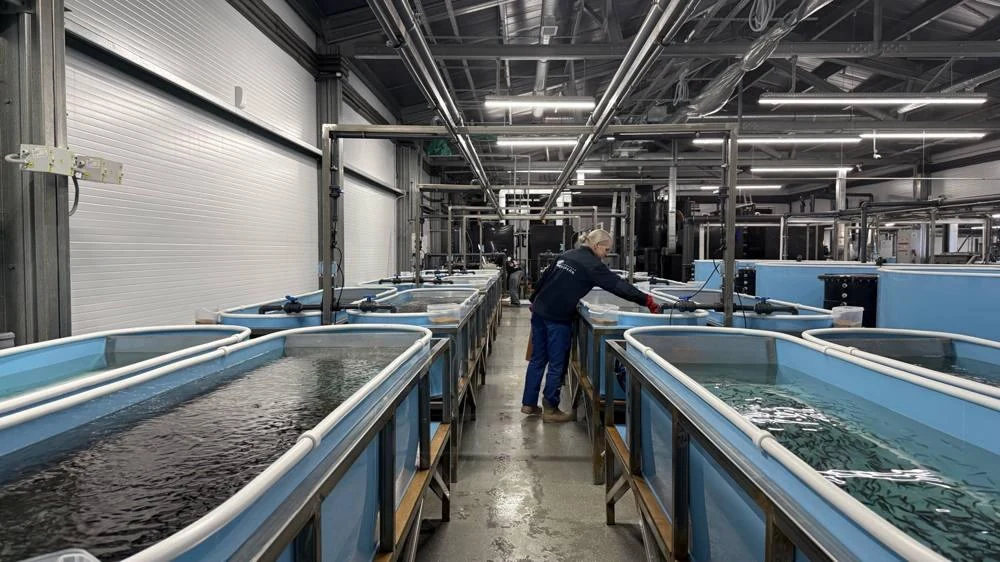
A tilapia farm needs a harvest schedule before it needs a tank specification. Decide what size fish you can sell, how often buyers will take them, and what size juveniles you can obtain. Those decisions determine the growing period, the amount of fish on site and the daily load on the water treatment system.
There are useful starting numbers. SRAC's tank-culture guidance gives 27–29°C for optimum growth and an operating dissolved oxygen range of 5.0–7.5 mg/L. For growth, a published small-scale RAS trial took Nile tilapia from about 8 g to 0.73–0.92 kg in 210 days at 26°C. The two results came from different generations of the same breeding line. These are reference conditions and observations, not a promise that every stock will perform alike. SRAC 282; Santos et al., 2022.
Start with the fish and the product you intend to sell
“Tilapia” is not a complete stock specification. Record the species or hybrid, strain, sex composition, average entry weight and size range. Nile tilapia, Oreochromis niloticus, is widely farmed, but a growth record for one strain does not automatically describe another. Ask for the supplier's batch records and health documentation, together with an explanation of how the sex composition was established.
Male monosex stocks are commonly used to improve grow-out consistency and limit unwanted reproduction. Females and males in a mixed batch do not necessarily reach the same sale size together. In densely stocked tanks, breeding behaviour may be suppressed, but differences in growth between sexes still affect grading and harvest. FAO, Nile tilapia production; SRAC 282.
Buying graded juveniles and running a hatchery are different businesses. A hatchery adds broodstock, larval rearing and nursery space. Buying juveniles makes reliable delivery part of the farm's production capacity: an empty tank still has costs, and a late batch moves a later harvest.
Agree the product with buyers before choosing the final weight. Whole live fish, chilled fish and fillets need different handling and processing arrangements. Keep fillet yield separate from live-weight production. One tonne of fish harvested is not one tonne of fillets available to sell.
Set water-quality targets for production
Tilapia's ability to survive poor conditions is not a reason to operate there. Set targets that support feeding and growth, then specify warning levels and the response to each alarm. The fish, biofilter and gas-removal equipment share the same water, but they do not have identical requirements.
| Parameter | Starting reference | Practical meaning |
|---|---|---|
| Temperature | 27–29°C in SRAC tank-culture guidance | Calculate winter heating and summer cooling loads |
| Dissolved oxygen | 5.0–7.5 mg/L in the same guidance | Measure in the tanks, including during heavy feeding |
| pH and alkalinity | SRAC suggests 6.8 as a lower pH limit for biofilter operation | Choose a working band and track buffering capacity |
| Ammonia and nitrite | Set limits for the fish, water chemistry and analytical units | Read TAN with pH and temperature; keep mg N/L distinct from mg compound/L |
| Carbon dioxide | Include removal capacity in the design | An acceptable oxygen reading does not measure carbon dioxide |
| Salinity | Match the water source to the chosen stock | Do not assume tolerance means unchanged growth |
The numerical starting references above come from DeLong, Losordo and Rakocy, Tank Culture of Tilapia, SRAC 282. They are not a complete operating specification. In particular, a biofilter can acclimate to different conditions; 6.8 should not be presented as a biological on/off switch.
Do not add salt simply because tilapia can tolerate it. In a 2025 study of Nile tilapia juveniles initially averaging 5.93 g, freshwater groups gained more weight than the higher-salinity groups in both experiments. The authors favoured 0–5 ppt for those juveniles. This supports checking the actual stock and source water, rather than prescribing one salinity to every tilapia RAS. Brackish-water projects also need an acclimation plan and a biofilter suited to the intended water. Vitukawalu et al., 2025.
Build a growth schedule from a defined starting weight
Two farms can both report a six-month cycle and be doing different work. One may stock fry; the other may buy juveniles that have already spent weeks in a nursery. A useful growth record includes the entry weight, harvest weight and conditions between them.
| Published example | Entry → final mean weight | Period | Where it applies |
|---|---|---|---|
| Nile tilapia, GST generations G20/G25 | 7–8 g → 726/920 g | 210 days | Small experimental RAS at 26°C |
| Male monosex Nile tilapia, UVI system | 79.2 g → 813.8 g | 24-week tank cycle | Tropical recirculating aquaponics with staggered stocking |
The GST experiment used 0.25 m³ tanks stocked initially at 80 fish/m³. Sex composition was not reported in the methods. A bacterial infection caused losses late in the trial, so the final weights do not imply perfect survival. Santos et al., 2022, methods and results.
The UVI figures describe an established aquaponic arrangement, including plant beds and its own treatment and stocking strategy. Reported Nile tilapia survival was 98.3%, final biomass density 61.5 kg/m³ and FCR 1.7. Those values help explain the result; they do not turn it into a specification for a different indoor farm. SRAC 454, UVI production data and 24-week cycle.
For your own schedule, divide grow-out into the weight ranges actually covered by the supplier's records or comparable trials. Give each stage a duration, tank allocation, expected survival and daily feed allowance. An 8 g fish cannot enter the 80 g stage on delivery day. Equally, a fish bought at 80 g does not need the nursery time counted again.
Check more than average weight. If the buyer accepts fish from 700 g upwards, an average of 700 g leaves some of the batch below specification. Use sample size distributions to plan selective harvests or grading, and reserve the space and labour those operations require.
Choose stocking density around the whole system
Density means standing biomass divided by the water volume actually available to the fish. For example, 4,000 kg in 100 m³ is 40 kg/m³. At 800 g each, that is 50 fish/m³. The same 50 fish/m³ at 80 g is only 4 kg/m³, which is why a stocking number without fish size says little about the load near harvest.
SRAC describes roughly 30 kg/m³ as a rule-of-thumb maximum for strongly aerated tank systems, while some designs with supplemental oxygen operate at 90–120 kg/m³. These describe different system capabilities, not interchangeable targets. SRAC 282, biomass density and oxygen supply.
Start the engineering calculation with the busiest feeding day. Check whether the system can supply oxygen, remove solids, process ammonia and strip carbon dioxide at that load. Then check the same production schedule during a pump failure, oxygen interruption, harvest or filter service. A tank that supports its normal load but cannot be isolated or harvested is difficult to operate. SRAC 453, RAS design and loading.
Keep nursery, grow-out and holding capacity separate in the layout. A final holding tank may be needed for sale or off-flavour management; occupying a grow-out tank for that purpose delays its next batch. Grading equipment, feed storage and safe access to valves also take space.
Calculate annual yield and feed demand separately
Here is a deliberately simplified example. Assume a 100 m³ tank is stocked with 5,000 fish at 80 g, all survive, and all are harvested at 800 g after 168 days. Allow seven more days to empty, clean and prepare the tank. These are planning assumptions chosen to show the arithmetic, not a recommended density, survival rate or guaranteed cycle.
| Calculation | Result |
|---|---|
| Initial biomass: 5,000 × 0.08 kg | 400 kg |
| Harvest biomass: 5,000 × 0.8 kg | 4,000 kg |
| Biomass gain: 4,000 − 400 kg | 3,600 kg |
| Average turns: 365 / (168 + 7) | 2.09 per year |
| Long-run average harvest: 4,000 × 365 / 175 | About 8.34 tonnes/year |
| Feed at an assumed FCR of 1.5: 3,600 × 1.5 | 5,400 kg per batch |
If the first batch is stocked on day zero, this schedule produces two complete harvests in the first 365 days: eight tonnes. The 8.34-tonne figure is an annualised average over repeated cycles. On a staggered farm, calculate actual harvest dates across all tanks and add them; do not multiply every tank's maximum biomass by an unsupported number of turns.
FCR relates feed to biomass gain. In this example, multiplying 4,000 kg of harvest by 1.5 would overstate feed because the fish already weighed 400 kg when stocked. Real records are less tidy: fish die, batches move and stocks remain at year-end. Use one consistent method for those adjustments, and track feed purchased per kilogram sold separately for cash planning.
The average feed use here is about 32 kg/day during grow-out. That is not the required treatment capacity: daily demand changes as the fish grow. Size the equipment against the feed schedule and its peak, then test what happens if growth is slower, FCR worsens or the buyer delays a collection.
Match indoor tilapia farming to the local climate
A warm climate can reduce heating demand, but it does not eliminate temperature control. Sun on the building, warm make-up water and equipment heat can push water above the chosen target. At a cold site, the same plan may depend on insulation and an affordable heat supply. Calculate the heat balance for seasonal conditions rather than using annual average air temperature.
Water reuse also needs a daily water balance. Add up make-up water, filter flushing, cleaning and discharge streams. A claim such as “99% recirculation” does not tell you how many cubic metres must be supplied each day unless the flow basis is stated.
During operation, a missed growth target should trigger a short investigation. Check the weighing sample, calibrate the feeder, look for uneaten feed, and compare oxygen, temperature, pH and nitrogen readings through the feeding day. Review mortality and recent transfers. Increasing feed is useful only when fish can eat it and the treatment system can handle it.
Bring the proposed stock, harvest size, weekly sales and site information into the first design discussion. You can then assess a turnkey tilapia farm against a clear production requirement. The RAS technology overview explains the treatment loop, while farm design and engineering connects that loop to the building, utilities and harvest schedule.
Frequently asked questions
How long does tilapia take to grow in RAS?
Published examples include about 8 g to 726–920 g in 210 days in a small RAS at 26°C, and 79.2 g to 813.8 g over a 24-week cycle in UVI's recirculating aquaponic system. Use the starting weight and system conditions when applying either example; they are not two estimates of the same cycle. GST trial; UVI data.
What is the best stocking density for tilapia?
Choose the density your system can support at peak feeding load while meeting growth, water-quality and handling requirements. State both kg/m³ and the associated fish size. A published high density is useful only with its oxygen, filtration and operating conditions.
Can tilapia grow in brackish water?
Some stocks can, but survival and good growth are different tests. Confirm the species, strain, life stage and acclimation requirements, then check performance at the intended salinity and the suitability of the biofilter. Do not assume adding salt will improve a freshwater production plan. Juvenile Nile tilapia salinity experiment.
Can I use the same FCR in every business plan?
No. Use records for comparable stock, feed and conditions, and test a less favourable case. State whether the figure means feed per kilogram of biomass gain or feed purchased per kilogram sold. That distinction affects both feed budgets and comparisons between farms.