
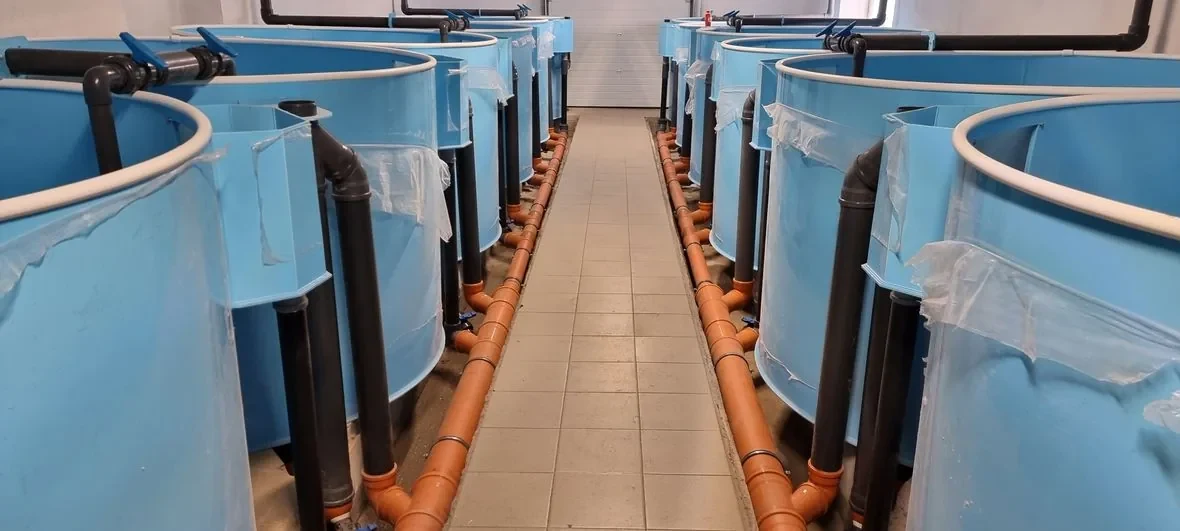
A land-based fish farm in Saudi Arabia or the GCC needs a design built around its water source and summer cooling load. Recirculation reduces the amount of new water passing through the fish tanks, but the farm still needs water for losses, cleaning and harvest operations. It also needs a practical way to remove heat and discharge waste.
The first investment decision is therefore often the site. A less expensive plot can become the more expensive farm if it requires extensive water treatment, a long power connection or year-round cooling. Aquafarmer's team in Astana can help develop the production plan, compare site options and define the engineering and equipment scope for a regional enquiry.
Start with a daily water budget
Saudi Arabia's National Water Strategy identifies scarce renewable water and pressure on non-renewable groundwater as central challenges. That makes the volume and reliability of a proposed farm's supply a business question as well as an engineering one. Source: Saudi Ministry of Environment, Water and Agriculture.
A percentage such as “99% recirculation” is not a daily water requirement. It may compare the recirculating flow with incoming water, rather than describe how much of the farm's water is replaced each day. The proposal should state cubic metres per day, peak demand and litres per kilogram of saleable fish, with the calculation boundary clearly defined.
For example, take a proposed farm selling 500,000 kg a year. Suppose its water balance requires 100 m³/day for the production system and another 15 m³/day for other uses. That is 115 m³/day, or 41,975 m³/year: approximately 84 litres per kilogram sold. These are illustrative inputs, not an expected consumption rate for a GCC farm. A supply limited to 80 m³/day cannot support this plan without reducing demand or adding a source; a storage tank can cover an interruption, but not a permanent shortage.
The balance should include filter backwash, evaporation, sludge removal, cleaning, stock reception and harvest handling. If processing or evaporative cooling uses water, include those flows too. The wastewater route matters at the same stage: a concentrated waste stream still needs collection, treatment or removal.
Choose the farm around the water you can obtain
The delivered water specification is more useful than its label. “Groundwater” does not tell you salinity, and “desalinated” does not tell you the final mineral balance or disinfectant residual at the farm. Sample the actual source and establish its available flow and seasonal temperature before choosing treatment.
| Source | What determines the design | What belongs in the budget |
|---|---|---|
| Groundwater | Salinity, dissolved gases, iron, manganese, alkalinity and sustainable available flow | Abstraction, preparation, storage and any treatment residues |
| Municipal or purchased desalinated water | Delivered composition, disinfectant residual, supply pressure and continuity | Connection, delivered water, storage and conditioning |
| Brackish water | Suitability for the chosen species and life stage, and for the biological treatment system | Compatible materials and treatment; desalination only if justified |
| Seawater | A marine production plan, intake conditions and discharge arrangements | Intake preparation, corrosion-resistant equipment and a marine treatment design |
On-site reverse osmosis creates a second water balance. If a unit is assumed to recover 50% of its feed as usable water, producing 100 m³/day requires 200 m³/day of feed water and leaves about 100 m³/day of concentrate, before other losses. Fifty per cent is an arithmetic assumption here, not a design recovery rate. The actual membrane process has to suit the feed water, and the concentrate needs a viable destination.
This is why desalination should be compared with purchasing suitable water, choosing another site or assessing a species suited to the available salinity. The cheapest cubic metre at the source may not be the cheapest cubic metre ready for fish.
Coastal humidity changes the cooling decision
Saudi Arabia's Fourth National Communication describes hot, dry inland summers and humid coastal summers. A cooling concept for an inland site cannot simply be copied to Jeddah or the Gulf coast. The relevant differences include humidity and winter conditions as well as peak summer temperature. Source: Saudi Arabia, 2022, section 1.1.3.
Direct evaporative cooling is limited by the incoming air's wet-bulb temperature, which reflects its moisture content. Humid air leaves less room for cooling by evaporation. The method also adds moisture to the air and consumes water. Those physical limits are explained in Pacific Northwest National Laboratory's evaporative-cooling guidance; they are not specific performance claims for a fish farm.
For a fish hall, the practical consequence is to calculate air treatment and water cooling together. Tanks and filtration already release moisture. Cooling the incoming air does not prove that the culture water will remain at its target temperature. Refrigeration may be required, and its condenser must reject heat at the site's summer conditions. Equipment selection needs those conditions, not just a catalogue rating.
The same approach applies to sites in the UAE and other GCC countries: use local temperature and humidity data, the building design and the actual source-water temperature. A national or regional average is too broad to size the system.
How much does warm incoming water add to the load?
A simple calculation shows why water supply and cooling cannot be priced separately. Assume 100 m³ of freshwater arrives each day at 32°C. Compare two possible target temperatures without treating either as a recommendation for a particular species.
| Illustrative target | Temperature reduction | Heat to remove from incoming water | Average load over 24 hours |
|---|---|---|---|
| 28°C | 4°C | About 465 kWh of heat/day | 19.4 kW thermal |
| 16°C | 16°C | About 1,861 kWh of heat/day | 77.5 kW thermal |
The calculation is water volume × temperature change × approximately 1.163 kWh per m³ per °C. It covers only the incoming freshwater. Heat entering through the building, pumps and other processes changes the total; heat recovery can reduce the incoming-water load. Peak demand also changes if the water arrives in a few hours rather than evenly through the day.
These thermal kWh are not electrical kWh. The electricity required by a chiller depends on its efficiency at the selected water and outdoor temperatures, plus pumps and fans. A warmer-water species can reduce the temperature difference in this example, but it does not make cooling free or unnecessary.
Connect species choice to a saleable product
Tilapia is one candidate for a warmwater project, but a viable species choice starts with buyers: whole or filleted, fresh or frozen, at what size and in what weekly volume. A local-origin claim alone does not establish the price a buyer will pay. Use a net selling price after packing, chilling, transport and any selling commissions.
For each shortlisted species, the production plan must identify a workable source of juveniles and feed. Imported stock brings transport time and receiving arrangements into the project; regular stock deliveries also determine how reliably the farm can harvest. A coldwater option needs enough sales value to cover its different temperature-control requirement.
A 500-tonne annual sales target means roughly 9.6 tonnes every week on average. A buyer for an occasional trial shipment is useful, but does not fill that schedule. If only part of the output can be sold at the intended premium, the budget should use a weighted price across the actual channels.
Aquafarmer's tilapia farm options can serve as a starting point for a grow-out concept. The final choice should connect the market, stock supply and site costs before tank dimensions are fixed.
Develop a site-specific proposal with Aquafarmer
For an initial enquiry, send the country and site location, intended species, annual sales target and product form. Building or plot drawings, water analysis and available electrical capacity make the first comparison more useful. If there are several possible sites, include them: the early study can show which differences affect investment and operating cost most.
The proposed scope should identify the production equipment and the work outside it: civil construction, external connections, source-water preparation, cooling, wastewater handling and backup systems. Local surveys, approvals, import arrangements, installation and ongoing service also need a responsible party and a budget. These arrangements are agreed for the selected country and site.
Business planning connects expected harvests and sales to the investment and monthly cash needs. Design and engineering develops the layout, water balance, treatment and utility loads. Contact the team in Astana to discuss a Saudi Arabia or GCC project and the work needed for a meaningful estimate.
Frequently asked questions
Can RAS make a site with very little freshwater viable?
It can reduce new-water demand, but the available supply still has to cover the complete daily balance and peak uses. First compare the proposed demand with the reliable supply. A high recirculation percentage alone does not establish that the site has enough water.
Does every GCC fish farm need desalination?
No. Suitable purchased water, a usable groundwater source and a marine farm lead to different designs. Desalination becomes one option when the source does not meet the selected production requirements; its energy, maintenance and concentrate handling belong in the comparison.
Can an evaporative cooler replace a chiller?
Only where the site's temperature and humidity conditions and the farm's heat balance support that solution. Cooling the air is not the same as cooling the fish water. Humid coastal conditions reduce the available evaporative cooling, so the full summer load needs to be checked.
Should I choose the fish or the site first?
Develop a short list of both together. A buyer may justify a particular species, but an unsuitable water source or cooling requirement can change its economics. Comparing two realistic species-and-site combinations is more useful than designing a farm around an untested assumption.